Tina in Panama: From the Fourth Bridge to a $2.6 Billion New Port – What Signals Is a Market Defined by Infrastructure Sending?
Panama City, Late July 2026
Heading south from Costa Rica, Tina arrives at the “home base” of her Latin American journey — Panama. This is our regional headquarters and the very “crossroads” of Latin American building materials trade.
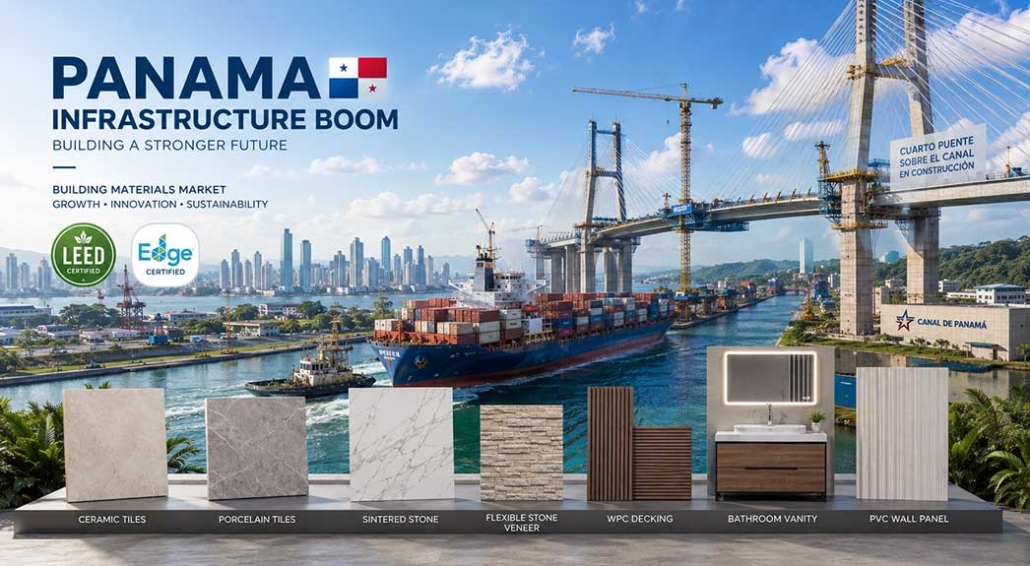
In 2026, Panama stands on an unprecedented infrastructure wave. The Panama Canal Authority’s 2026 budget reaches US$5.2 billion. The construction sector is projected to grow at 5.2% annually from 2026 to 2029, contributing approximately 14% of GDP. Panama is not just Central America’s building materials hub — it is one of Latin America’s largest markets for ceramic tiles, porcelain tiles, floor tiles, sintered stone, flexible stone veneer, WPC decking, bathroom vanities, and PVC wall panels.
Three “Infrastructure Engines” Driving Panama’s Building Materials Market
Engine One: The Panama Canal – A $2.6 Billion New Port Era
In July 2026, the Panama Canal Authority released pre-qualification documents for a new port project — a core component of the Canal’s 2025–2035 Strategic Plan. Total investment: US$2.6 billion, with an estimated three-year construction period. The project will build maritime terminals on both the Atlantic and Pacific sides, adding 5 to 6 million TEUs of annual container transshipment capacity.
The Canal Authority President stated: “The Canal is entering a new phase. Water security projects, new port terminals, energy corridors, and logistics platform expansion — these projects represent opportunities for economic diversification and strengthening national competitiveness.”
Every port terminal, every energy corridor demands massive building materials — from structural floor tiles for industrial facilities to porcelain tiles for administrative buildings and sintered stone countertops for staff areas.
Engine Two: The Fourth Bridge – Panama’s “Project of the Century”
The Fourth Bridge over the Panama Canal is a road-rail cable-stayed bridge with a main span of 510 meters. As of June 2026, construction progress has reached 37%, with delivery expected in 2028. The Panama Construction Chamber delegation gave high praise after inspecting the project in April 2026.
For suppliers of flexible stone veneer and bendable stone panels, bridge infrastructure projects create demand for durable, weather-resistant architectural surfaces. WPC decking and outdoor flooring are increasingly specified for pedestrian walkways and observation areas.
Engine Three: Urban Infrastructure Upgrades
Major projects continue to advance: Panama Metro Line 3, the Pan-American Highway expansion, and the Calle 50 urban renovation project using permeable concrete and light-colored local bricks to reduce heat island effects. The 2030 Strategic Infrastructure Plan allocates over US$3 billion for roads, bridges, and public transport systems. In 2024, construction investment exceeded US$870 million — and the number is still growing.
Modern transit stations require porcelain tiles for durable flooring, bathroom vanities and one-piece toilets for public facilities, and LED mirrors for energy-efficient restrooms. Commercial developments along new transit corridors are specifying sintered stone for façades and PVC wall panels for moisture-resistant interiors.
Panama’s Green Compliance Shift
Beyond the infrastructure boom, Panama is undergoing a profound green transformation.
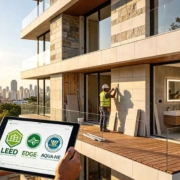
The Panamanian government has set a clear target: by 2025, 70% of building stock will integrate renewable energy solutions. Currently, over 21,000 square meters of projects have achieved LEED or EDGE certification. Developers are actively integrating solar panels, smart lighting, and greywater recycling systems. The Panama Green Building Council is promoting low-carbon materials and energy efficiency across commercial and residential projects.
This means two things for building materials suppliers: speed and green. Projects demand rapid supply chain response, and they require certified green products — including low-emission PVC wall panels, recycled-content ceramic tiles, and responsibly sourced WPC decking. Both are our core strengths.
Our Home Advantage in Panama
Panama is our “home turf” — not just a slogan, but real competitive advantage.
Local service team. We have on-the-ground presence, eliminating time zones and language barriers with same-day response. We understand local regulations, customs, and business culture.
Logistics efficiency. Leveraging the Panama Canal and the Colón Free Trade Zone, we achieve efficient regional distribution — serving both local projects and broader Latin American markets.
One-stop integration. From infrastructure materials for the new port, structural steel for the Fourth Bridge, specialty materials for Metro Line 3, to green finishing materials for commercial projects — including floor tiles, porcelain tiles, bathroom vanities, sintered stone, flexible stone veneer, WPC decking, and waterproof wall panels — full-category integration, project packaging, one procurement.
Panama is experiencing a building materials market surge driven by Canal strategy, infrastructure investment, and green transformation. US$5.2 billion Canal budget, 5.2% annual industry growth, a US$2.6 billion new port, and 37% progress on the Fourth Bridge — behind every number lies real demand for building materials.
Only suppliers with rapid response, full-category integration, and green compliance capability can create true value.
Tina is in Panama City now. If you need a reliable green building materials partner — whether for ceramic tiles, sintered stone countertops, flexible stone panels, WPC decking, bathroom vanities, or PVC wall panels — for your Panamanian project, reach out to us.
Latin America is vast. But we are always by your side.