Posts

July 18, Tina Arrives in San Pedro Sula – When Honduras’ Infrastructure Boom Meets Green Compliance Answers

Tina flies in from Caracas, bringing insights from Venezuela’s reconstruction frontlines, ready to begin her client visit in Honduras — the country’s economic and industrial heart.
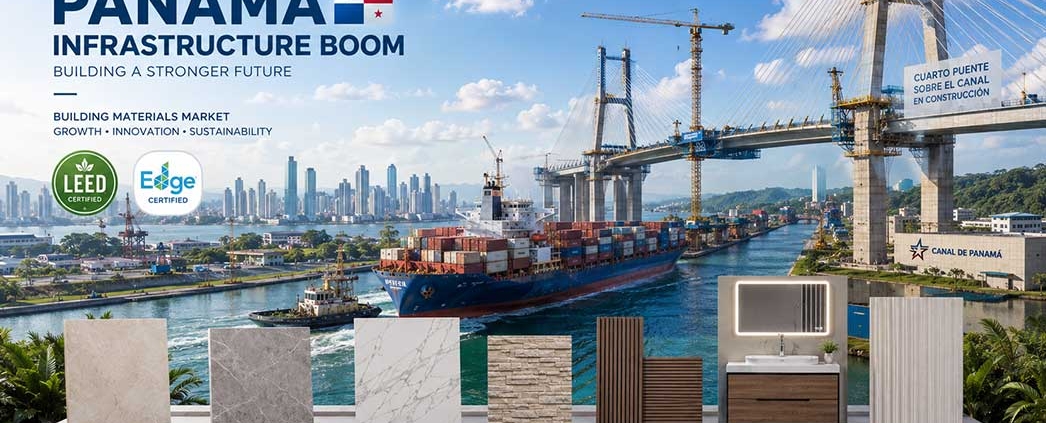
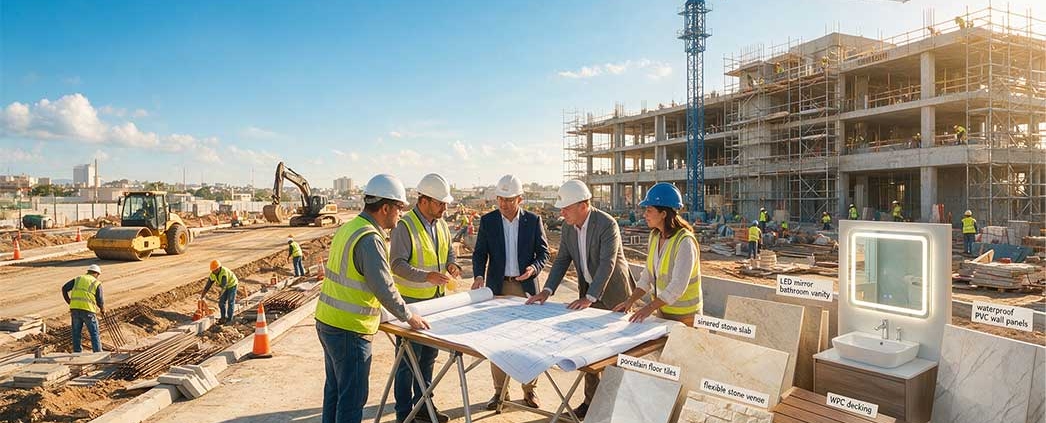
Why Honduras? Because a “quiet revolution” is unfolding in its building materials market. In 2026, public investment will reach a record 104 billion Lempiras (approximately US$4 billion) — 10% of GDP, one of the highest ratios in the Americas. Roads, hospitals, schools, and energy infrastructure — massive projects are lining up. Meanwhile, building materials imports grew 34.78% from 2023 to 2024, with a 45.07% CAGR from 2020 to 2024. This market needs a partner delivering one-stop green compliant solutions — from ceramic tiles and porcelain tiles to sintered stone, flexible stone veneer, WPC decking, bathroom vanities, and PVC wall panels.

104 Billion Lempiras – Honduras’ “Year of Infrastructure”

Honduras’ 2026 budget reaches 469.25 billion Lempiras (US$17.995 billion), up 8% from 2025. Public investment of 104 billion Lempiras breaks the 100 billion mark for the first time.
Key allocations: 8 billion Lempiras for roads, 4.3 billion for hospitals, 2.5 billion for energy, and 3.4 billion for schools. The Puerto Cortés Hospital — a 15,000-square-meter, 200-bed facility — is under development with Spanish firm Dominion. The US$18 billion “Land Canal” project signals infrastructure ambition far beyond current projects.
Every Lempira of public investment becomes a procurement order. Floor tiles for schools, sintered stone countertops for institutional kitchens, porcelain tiles for healthcare facilities — demand is surging across every category.

Honduras’ “Compliance Shift”

Opportunity comes with conditions. In May 2026, Honduras issued new cement technical standards mandating ASTM compliance for all cement sold locally — domestic or imported. Mandatory registration, accredited lab testing, and Spanish labeling are now required.
The message is clear: compliance capability is market access. Building materials without international certification, test reports, and proper documentation will not enter Honduras.
This is our core strength. Every product we supply — from bathroom vanities and one-piece toilets to WPC decking and waterproof wall panels — undergoes rigorous compliance review. We handle certification, traceability, and localization so clients can focus on their projects.

What Tina Brings to San Pedro Sula

On July 18, Tina arrives with:
Deep market insight. Fresh from Venezuela, she carries real-time Latin American market intelligence — 45% import growth, record public investment, and new compliance standards reshaping the landscape.
One-stop solutions. Whether steel for roads, finishing for hospitals, or green materials for schools — full-category integration, one procurement, one delivery.
Rapid response. Our Panama-based team and Canal logistics enable efficient delivery from confirmation to shipment.
Green compliance. Understanding local standards and certification requirements — we ensure every product meets the mark.
Honduras is experiencing an unprecedented infrastructure wave — 104 billion Lempiras in public investment, the US$18 billion “Land Canal,” and surging import demand.
But only suppliers with compliance capability, full-category integration, and rapid response can create real value.
On July 18, Tina is in San Pedro Sula. If you need a reliable green building materials partner for your Honduran project — reach out to us.

Latin America is vast. But we are always by your side.

From China to Latin America: A Green-Compliant One-Stop Building Materials Supplier’s Rise to Industry Leader

Positioned as Latin America’s leading green-compliant one-stop building materials solution provider, our company has spent over a decade transforming from a Chinese exporter into a regional benchmark enterprise. We deliver integrated solutions combining project-based packaging, rapid response, and full-category consolidation — creating long-term value for customers across the Americas. Our product portfolio includes ceramic tiles, porcelain tiles, floor tiles, bathroom vanities, sintered stone, flexible stone veneer, WPC decking, and PVC wall panels.

Our Service Footprint

Our market coverage spans 70% of Central and South America, complemented by a growing presence in Africa, Central Asia, and the Middle East. We serve large wholesalers, retail chains, project contractors, small B2B buyers, and design studios — each with unique requirements demanding tailored solutions.

Our product system encompasses green, intelligent, and design-driven materials. From ceramic tiles and porcelain tiles for residential and commercial flooring to sintered stone and large slab countertops for kitchen surfaces; from bathroom vanities, one-piece toilets, and LED mirrors combining water efficiency with contemporary design to flexible stone and bendable stone veneer enabling curved facade innovations. Our WPC decking, WPC doors, and outdoor flooring deliver sustainable, low-maintenance outdoor solutions, while PVC wall panels and waterproof wall panels provide moisture-resistant, low-VOC alternatives for wet areas.

Three Core Differentiators

One-Stop Solution Provider. We are not merely a supplier — we are a solution enabler. Clients source their entire material requirement from a single partner, reducing procurement complexity and supplier management costs. From floor tiles to sintered stone to WPC decking, our full-category matrix ensures consistency in quality and delivery.

Panama-Based Localization. Our strategic Panama headquarters enables “same-day inquiry, same-day response” service. We understand each market’s regulations, from Brazil’s ABNT to Mexico’s NOM, with Spanish and Portuguese documentation and responsive technical support.

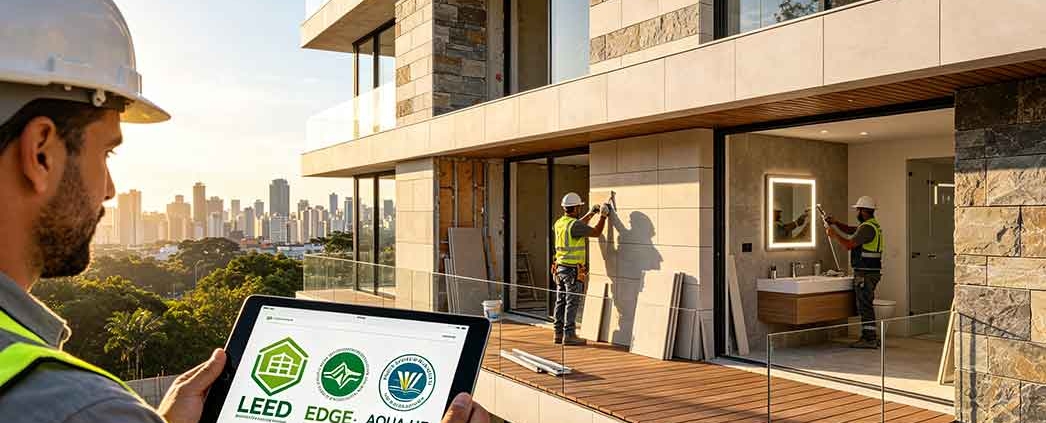
Green Compliance Leadership. Our products are pre-qualified for LEED, EDGE, and AQUA-HQE requirements. From low-emission PVC wall panels to recycled-content porcelain tiles and responsibly sourced sintered stone, we guide clients through the complex compliance landscape.

Creating Long-Term Value

For wholesalers, we consolidate multiple categories — from ceramic tiles and bathroom vanities to WPC decking and waterproof wall panels — simplifying procurement and reducing overhead. For contractors, our engineering packaging ensures on-time delivery of coordinated material sets. For design studios, our green-compliant, design-forward products — including flexible stone veneer and LED mirrors — enable sustainability goals without compromising aesthetics. We provide regulatory guidance, certification documentation, and technical training that help customers reduce costs, ensure compliance, and upgrade quality.

Looking Ahead

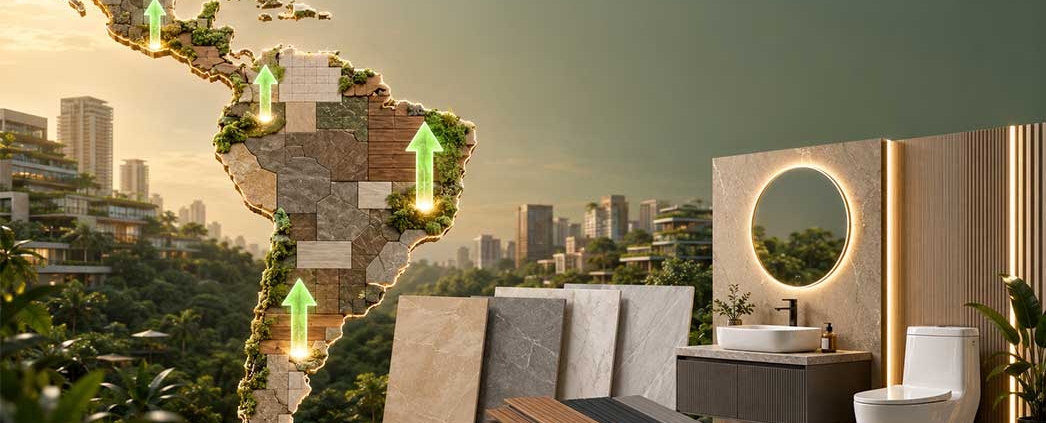
The Latin America green building materials market, valued at US$24.9 billion in 2025, is projected to double to US$49.8 billion by 2034. As a leading one-stop building materials supplier to Latin America, we are committed to deepening our presence, expanding our portfolio, and strengthening our green compliance capabilities. For suppliers of porcelain tiles, sintered stone countertops, WPC decking, bathroom vanities, flexible stone panels, and PVC wall panels, the region offers unparalleled growth opportunities — and we remain the partner of choice.

Latin America Green Building Materials Market: From $24.9B to $49.8B – Who’s Driving the Green Revolution?

The Latin America green building materials market reached US$24.9 billion in 2025 and is projected to double to US$49.8 billion by 2034, representing a compound annual growth rate of 7.76%. This remarkable growth is fueled by three powerful forces: government regulations mandating sustainable construction, rising environmental awareness among consumers, and strong demand for green materials across residential, commercial, and infrastructure projects. For suppliers of ceramic tiles, porcelain tiles, floor tiles, bathroom vanities, sintered stone, flexible stone veneer, WPC decking, and PVC wall panels, this market expansion represents a significant opportunity to establish a presence in one of the world’s fastest-growing construction regions.

Four Key Drivers of Market Growth

Government Regulations and Sustainability Initiatives
Latin American governments are implementing increasingly stringent building energy codes and carbon reduction policies. Mexico’s Sustainable Building Law (2023) mandates green materials for all public infrastructure projects. Brazil strengthened its ABNT green building standards in 2025, while Colombia’s Resolution No. 0194 of 2025 updated national sustainable construction guidelines. These regulatory frameworks create sustained demand for certified green materials across all construction segments.

Rising Environmental Awareness

Consumers across Latin America are increasingly concerned about the environmental impact of buildings. This awareness is forcing developers to incorporate green materials into their procurement specifications. From energy-efficient LED mirrors and water-saving one-piece toilets to low-VOC waterproof wall panels and recycled-content porcelain tiles, buyers are demanding products that minimize environmental footprint while delivering superior performance.

Urbanization and Population Growth

Rapid urbanization across Latin America is generating massive construction demand. As cities expand, green building practices become essential for sustainable urban development. This trend drives demand for sintered stone countertops in new kitchens, flexible stone veneer for architectural facades, and WPC decking for outdoor spaces in residential and commercial projects.

International Capital Pressure

International financial institutions are imposing increasingly strict green financing conditions on Latin American projects. Colombian banks offer 0.5–2% interest rate reductions for LEED or EDGE certified projects, creating a powerful financial incentive for developers to specify certified materials. This trend is accelerating adoption of green building certification systems across the region.

Green Building Practices Across Latin America

Argentina has embraced green building certification, with notable LEED-certified projects including Alvear Tower and GNP Seguros Tower in Buenos Aires. The National Housing Institute has established green building standards that are shaping residential construction practices across the country.
Brazil leads the region in green building adoption, with São Paulo’s 71% of luxury developments holding green certification — surpassing Miami, Los Angeles, and New York. The country’s extensive LEED-certified project portfolio (over 1,000 projects) sets the benchmark for sustainable construction in Latin America.
Peru is integrating renewable energy systems and smart water management into major developments in Lima, demonstrating the region’s growing commitment to holistic sustainability. These projects create demand for sustainable bathroom vanities, water-efficient one-piece toilets, and energy-saving LED mirrors.
Across all these markets, suppliers of ceramic tiles with recycled content, sintered stone with responsible sourcing, flexible stone panels for innovative facades, WPC doors for durable interiors, and PVC wall panels with low emissions are finding growing acceptance.
Green building materials are not a passing trend — they are an established market reality. The US$24.9 billion Latin America green building materials market is just the beginning. By 2034, this market will double to US$49.8 billion. For suppliers of porcelain tiles, floor tiles, sintered stone countertops, bathroom vanities, flexible stone veneer, WPC decking, and waterproof wall panels, the question is not whether to enter this market, but how quickly they can establish green compliance, local partnerships, and supply chain capabilities. The green revolution in Latin American construction is here — and it is accelerating.

Mexico Green Building Materials Market 2026: $1.2 Billion Opportunity Under the Sustainable Building Law

Mexico’s green building materials market is valued at approximately US$1.2 billion and is projected to grow at a CAGR of 11.97% through 2034. In 2023, the government implemented the “Sustainable Building Law,” mandating green materials for all public infrastructure projects — covering roads, bridges, schools, and hospitals. This policy is reshaping procurement and creating a structural entry point for suppliers of ceramic tiles, porcelain tiles, floor tiles, sintered stone, flexible stone veneer, WPC decking, bathroom vanities, and PVC wall panels.

Policy-Driven Market Transformation

Mexico’s Sustainable Building Law requires all public works to use certified green materials, driving sustained demand for compliant products. The NOM-251-SE-2025 steel standard, effective February 2026, imposes mandatory certification requirements on steel imports, signaling stricter compliance across all building material categories. In 2025, Mexico published its “Sustainable Building Green Financing Guide,” reducing capital costs for developers who adopt sustainable materials. Additionally, Minergie was approved as a certification standard for Mexico’s low-carbon building bonds in December 2025, while LEED certification continues to grow — Mexico ranked sixth globally in the USGBC’s 2024 rankings. For suppliers of porcelain tiles with recycled content, sintered stone with responsible sourcing, and low-VOC PVC wall panels, these regulatory tailwinds create immediate and sustained market demand.

Product Opportunities in the Mexican Market

The Mexican market offers substantial opportunities across multiple green building product categories. The lightweight building materials market reached US$6.54 billion in 2025, with recycled steel, cross-laminated timber, and autoclaved aerated concrete in high demand. Hempcrete is projected to grow from US$210 million to US$1.06 billion by 2031 at a 31.2% CAGR.
Beyond these, demand is surging for ceramic and porcelain tiles with recycled content and low-emission production, sintered stone and large slab countertops valued for durability and heat resistance, WPC decking and WPC doors for outdoor and resort applications, bathroom vanities, one-piece toilets, and LED mirrors meeting water and energy efficiency requirements, and PVC wall panels and waterproof wall panels offering low-VOC, moisture-resistant solutions for wet areas. As a floor tiles supplier to Latin America or a sintered stone supplier to Mexico, companies that document sustainability credentials will win specifications in government and private projects alike.

What This Means for Chinese Suppliers

Mexico is a critical export destination for Chinese building material suppliers. Success requires mastering three essentials: understanding Sustainable Building Law compliance documentation, staying ahead of evolving NOM standards, and building localized service capabilities with Spanish-language support. Suppliers of flexible stone veneer, bendable stone panels, WPC decking, bathroom vanities, and waterproof wall panels who invest early in compliance and local partnerships will capture significant market share in this fast-growing market.
Mexico’s green building materials market, valued at US$1.2 billion and growing at nearly 12% CAGR, represents one of Latin America’s fastest-growing opportunities. The Sustainable Building Law, NOM standards, and expanding certification options are creating sustained demand across all product categories. Suppliers who invest in compliance, documentation, and local partnerships will lead this market transformation.

LEED, EDGE, AQUA-HQE: Your Guide to Latin America Green Building Certifications 2026

Green building certifications have become the “access language” for the Latin American building materials market. Without understanding these certification systems, it is impossible to grasp what your customers truly need and expect. LEED, EDGE, and AQUA-HQE — three major green building certification frameworks — are defining procurement standards across the region. For suppliers of ceramic tiles, porcelain tiles, floor tiles, bathroom vanities, sintered stone, flexible stone veneer, WPC decking, PVC wall panels, and waterproof wall panels, knowing these certifications is not optional — it is the price of entry.

The Three Major Certification Systems Explained

LEED (Leadership in Energy and Environmental Design)
Developed by the U.S. Green Building Council (USGBC), LEED is the most widely recognized green building certification globally. Brazil leads Latin America with over 1,000 LEED-certified projects, while adoption is growing rapidly in Colombia, Mexico, Chile, and Costa Rica. Many public projects across the region now mandate or give priority to LEED certification, making it essential for suppliers of building materials to understand LEED credit categories. Products like porcelain tiles with recycled content, sintered stone with regional sourcing, and low-VOC PVC wall panels can contribute valuable points toward LEED certification.
EDGE (Excellence in Design for Greater Efficiencies)
Developed by the International Finance Corporation (IFC), EDGE requires at least 20% energy savings, 20% water savings, and 20% reduction in embodied carbon in materials. This certification is particularly relevant for suppliers of water-efficient one-piece toilets, energy-saving LED mirrors, and durable WPC decking that reduces maintenance and replacement cycles. In Colombia, EDGE Advanced or LEED Gold/Platinum projects can access dedicated green financing, creating a strong commercial incentive for developers to specify EDGE-compliant materials.
AQUA-HQE (High Environmental Quality)
AQUA-HQE is a certification system that combines international standards with Brazilian regulations, making it highly influential in the Brazilian market. Based on the French HQE (Haute Qualité Environnementale) framework, AQUA-HQE is adapted to local climatic, regulatory, and cultural conditions. It evaluates buildings across 14 targets, including health, comfort, and environmental performance. For suppliers of bathroom vanities with sustainably sourced wood, flexible stone veneer with low environmental impact, and waterproof wall panels with low emissions, AQUA-HQE presents a clear pathway to market acceptance.

How Certifications Impact Building Material Procurement

Green building certifications impose clear technical specifications on building materials — from embodied carbon and recyclability to indoor air quality and VOC (Volatile Organic Compounds) content. Here is what each certification means for suppliers:
For ceramic and porcelain tiles, certifications reward products with recycled content, regional manufacturing, and low-emission glazes. A floor tiles supplier to Latin America who can document these attributes gains a competitive edge in LEED and EDGE projects.
For sintered stone and large slab countertops, LEED credits are available for materials with extended durability, low maintenance, and responsible sourcing. As a sintered stone supplier to Brazil and Colombia, demonstrating compliance with certification requirements is key to winning specification in high-end residential and commercial projects.
For flexible stone veneer and bendable stone panels, these innovative products contribute to design flexibility and thermal performance, earning credits under LEED’s Material & Resources category and EDGE’s embodied carbon metrics.
For WPC decking, WPC doors, and outdoor flooring, certifications reward materials with recycled content, long service life, and low maintenance. As a WPC decking supplier to Latin America, highlighting these attributes is essential for gaining acceptance in LEED and EDGE projects.
For bathroom vanities, one-piece toilets, and LED mirrors, EDGE’s water and energy efficiency requirements directly align with product performance. Suppliers who can provide third-party test reports for water consumption and energy use will win specifications in EDGE-certified developments.
For PVC wall panels and waterproof wall panels, low VOC emissions and indoor air quality compliance are critical for LEED’s Indoor Environmental Quality category and AQUA-HQE’s health targets. As a green panels supplier to South America, documenting these properties is the key to unlocking project specifications.
Suppliers who can provide the required test reports and compliance documentation will secure a significant competitive advantage. The ability to demonstrate certification alignment is becoming as important as product quality itself.

Recommendations for Chinese Suppliers

For Chinese building material suppliers looking to enter the Latin American market, building green compliance capabilities should be a top priority. Here are three essential steps:
First, invest in product certification. Understand which LEED, EDGE, or AQUA-HQE credits your products can contribute to, and obtain the necessary third-party testing and certifications. For ceramic tiles, sintered stone, and flexible stone veneer, this may involve recycled content verification; for one-piece toilets and LED mirrors, water and energy efficiency testing; for PVC wall panels and WPC decking, VOC emissions and durability testing.
Second, establish a compliance documentation system. Latin American buyers require comprehensive technical files, test reports, and certification documentation. Having these documents ready in both English and Spanish/Portuguese will significantly accelerate procurement decisions.
Third, build relationships with local certification consultants. Partnering with experienced local advisors who understand each country’s regulatory nuances will help navigate the complex certification landscape and position your products effectively.
LEED, EDGE, and AQUA-HQE are not just acronyms — they are the gateways to Latin America’s green building revolution. For suppliers of ceramic tiles, porcelain tiles, floor tiles, bathroom vanities, sintered stone, flexible stone veneer, WPC decking, PVC wall panels, and waterproof wall panels, understanding these certification systems is essential for success. The companies that invest early in certification alignment, documentation, and local partnerships will capture significant market share as the region’s green building regulations continue to tighten. The window of opportunity is open — compliance is the key.