Posts

2026 Latin America Green Building Materials Market: $24.9 Billion Green Opportunity — Who Is Leading the Race?

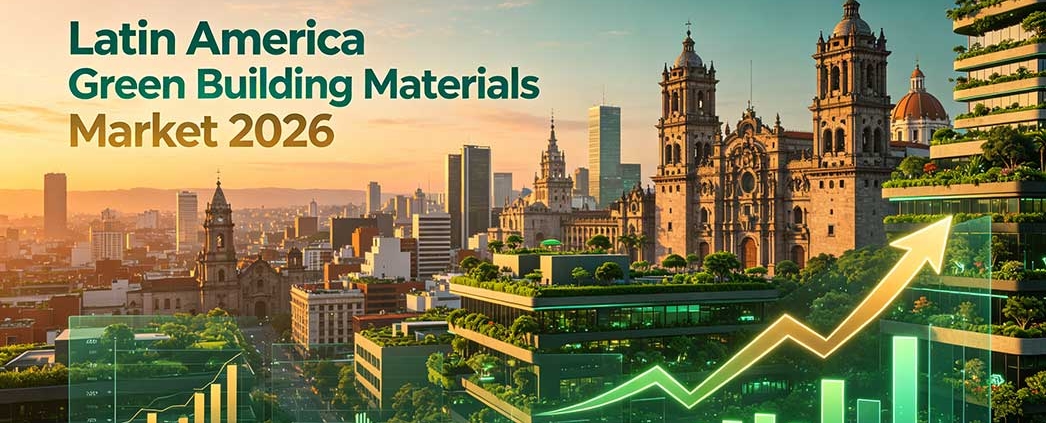
The Latin America green building materials market reached USD 24.9 billion in 2025 and is projected to double to USD 49.8 billion by 2034, registering a compound annual growth rate (CAGR) of 7.76%. The broader Latin America construction market was valued at USD 9.11 billion in 2024 and is expected to reach approximately USD 13.75 billion by 2034, growing at a CAGR of 4.20%. Driven by green building regulations, massive infrastructure investment, and rising consumer demand for sustainable construction, Latin America is emerging as one of the world’s most promising regions for building materials exports.

Three Growth Engines Powering the Latin America Building Materials Market

Infrastructure Investment on an Unprecedented Scale
Latin American governments are directing massive capital toward critical infrastructure. To meet the Sustainable Development Goals (SDGs), the region needs approximately USD 2.2 trillion in infrastructure investment to expand and maintain essential systems. Major projects are moving forward across the region:
Brazil’s “New Growth Acceleration Program” (Novo PAC) continues to expand, driving demand across multiple construction sectors
Panama Canal Fourth Bridge — a nearly USD 2 billion project
Panama Railway Project — approximately USD 4.1 billion in investment
This wave of infrastructure spending is creating sustained, long-term demand for construction materials across the region.

Green Building Regulations Are Becoming Mandatory
Across Latin America, governments are enacting laws that require sustainable materials in public works and new buildings:
Brazil strengthened its green building standards in 2025, with ABNT NBR performance requirements and voluntary certification systems (LEED, AQUA, EDGE) driving material CO₂ reduction and measured energy performance. Starting in 2027, all federal government buildings must achieve level “A” on the ENCE National Energy Conservation Label.
Mexico implemented its “Sustainable Construction Law” in 2023, mandating the use of green materials in all public infrastructure projects. This policy is fundamentally reshaping procurement patterns across the Mexican construction sector.
Colombia issued Resolution No. 0194 of 2025, updating national guidelines for promoting sustainable construction in new buildings. The resolution recognizes the Concrete Sustainability Council (CSC) as a reference criteria for demonstrating compliance with sustainable construction material requirements.
These regulatory shifts are transforming green building materials from a niche preference into a market access requirement.

Rising Middle Class and Evolving Consumer Preferences
Latin America’s expanding middle class is driving demand for green, intelligent, and high-quality building materials. Consumers are increasingly aware of the environmental impact of conventional construction and are actively seeking healthier, energy-efficient homes. This consumption upgrade is accelerating the adoption of sustainable materials across residential, commercial, and institutional projects.

Green Materials — From “Optional” to “Essential”

The green building materials market is growing at 7.76% CAGR — significantly outpacing the broader Latin America construction market’s 4.20% growth. This gap signals that sustainable materials are transitioning from a premium choice to a competitive necessity.
Key implications for industry players:
Compliance is becoming the price of entry — companies that fail to meet green standards risk being excluded from public tenders and large-scale projects
First-mover advantage — early adopters of green compliance will capture structural growth dividends as regulations tighten
Certification matters — LEED, EDGE, AQUA-HQE, and country-specific certifications are increasingly non-negotiable
Companies that establish green compliance capabilities early will capture this structural growth dividend as regulations tighten and buyer expectations rise.

The golden window for the Latin America green building materials market is wide open.

With the market set to double from USD 24.9 billion to USD 49.8 billion by 2034, the opportunity is unprecedented.
Who will lead this race? The companies that succeed will share three essential capabilities:
Green compliance — deep understanding of and adherence to evolving regulations across multiple countries
Full-category integration — the ability to offer complete, coordinated material solutions rather than individual products
Localized service — on-the-ground presence and understanding of each market’s unique requirements
The Latin America green building materials market is transforming from a fragmented landscape into a structured, regulation-driven industry. Those who move now to build green-compliant, integrated, locally-aware offerings will define the next decade of construction across the region.

Across 8 Countries, Deep in Latin America — July 2026, We Bring One‑Stop Building Materials Solutions to Your Doorstep

July 2026. While the northern hemisphere sizzles in midsummer, our team embarks on a journey that spans the length of Latin America. Starting from our headquarters in Panama, we will visit eight core markets – Colombia, Venezuela, the Dominican Republic, Jamaica, Costa Rica, Honduras, El Salvador, and Guatemala – and extend our reach to Chile and Uruguay in South America.
This is no ordinary business trip. It is a living commitment to our promise: to be Latin America’s leading provider of green‑compliant, one‑stop building materials solutions. We believe that markets are not built on spreadsheets, but on face‑to‑face trust. Ten years ago, we chose Panama as our gateway to the region. Today, we are deepening that connection – country by country, client by client, project by project.
Over the past decade, we have transformed from a supplier into a strategic partner for hundreds of distributors, contractors, and design firms across Central and South America. We have learned that local knowledge matters as much as product quality. That is why, this July, we are packing our bags – not to sell, but to listen, to learn, and to deliver value where it counts: right beside our customers.

Why These 10 Countries?

Our itinerary is not random – each destination represents a vital growth pole in the Latin America building materials market.
Colombia – South America’s second‑most populous nation, where construction contributes a significant share of GDP. In 2025, the sector is projected to grow by 1.6%, with an average annual growth of 5.1% from 2026 to 2029. The government plans to deliver 1.18 million housing units by 2030, of which 428,000 will be eco‑friendly, energy‑efficient homes. This creates surging demand for green products like energy‑efficient windows, eco‑paints, and photovoltaic accessories. As an Andean hub, Colombia also re‑exports to Peru, Ecuador, and Venezuela.
Venezuela – State‑backed housing projects continue to drive demand. Venezuela’s building materials market is expected to grow at a 6.8% CAGR from 2025 to 2031. China supplies 25% of Venezuela’s imports, with machinery and building materials leading the list – a trend that is set to intensify.
Dominican Republic – Its construction market was valued at US$38.95 billion in 2025 and is forecast to reach US$62.19 billion by 2030, with an annual growth of 4.1% from 2026 to 2029. Major projects – from the Punta Cana airport expansion to large residential communities – are underway.
Jamaica – Chinese contractors, including China Harbour Engineering, have won major housing and infrastructure bids, such as the 1,446‑unit social housing project and the Montego Bay ring road.
Costa Rica – A regional beacon for green construction, where bamboo, hempcrete, recycled concrete, and solar glass are widely adopted. Modular and sustainable building practices are gaining ground fast.
Guatemala – Its new building materials market already exceeds US$1 billion, with double‑digit growth expected. The World Bank approved a US$400 million credit line for rural roads, and a US$300‑million cable car project in the capital is nearing completion.
El Salvador – Construction grew a stunning 128% in 2023–2024, with the US, Guatemala, China, and Spain as top suppliers. New stadium and infrastructure projects are in the pipeline.
Honduras – Post‑diplomatic ties with China have unlocked cooperation, with completed agricultural school projects and new hospital tenders moving forward.
Chile – The construction market is projected to grow at 5% CAGR through 2034, reaching ~US$49.8 billion. The IDB approved a US$30 million loan for sustainable timber construction in 2025.
Uruguay – Construction is expected to grow 3.7% in 2025 and 3.5% annually through 2029, with US$8.9 billion in active projects as of May 2025.
Every one of these markets is a thriving ecosystem – and we are not spectators, but active contributors.

What Are We Bringing on This July Trip?

This July journey is not a sales pitch – it is a value‑delivery mission.
We bring deep market intelligence. Ten years on the ground have taught us the nuances of each country’s building codes, green compliance frameworks, procurement protocols, and cultural business etiquette. From Colombia’s green construction incentives to Costa Rica’s eco‑material trends – we know the rulebook better than most.
We bring one‑stop solution capabilities. We do not just sell building materials – we design integrated solutions. Whether you are a large wholesaler needing supply‑chain consolidation, a contractor requiring project‑based packaging, or a design studio seeking curated green products, our full‑category product matrix and engineering‑oriented bundling services can address every need.
We bring green‑compliance expertise. With regulations tightening – from LEED and EDGE certifications to country‑specific standards like Mexico’s Sustainable Building Law and Brazil’s ABNT NBR series – our product lines are already pre‑qualified for the region’s most demanding sustainability requirements. As we have highlighted in our earlier articles on Brazil’s COP30‑driven green market and Mexico’s policy‑led transformation, compliance is no longer optional – it is the price of entry, and we have paid it in full.
We bring the Panama hub speed. Our strategic location at the crossroads of the Americas, combined with a dedicated local service team, enables a “same‑day inquiry, same‑day response” turnaround that few competitors can match.

Our Customers’ Voices Guide Our Path

Every visit is a listening session.
Distributors tell us how our full‑category integration reduces their supplier management costs. Contractors share how our project‑bundling service ensures on‑time delivery, even for complex, multi‑site jobs. Design studios reveal that our green‑certified, aesthetics‑focused products give their projects a competitive edge in a market that increasingly rewards sustainability.
These insights have driven continuous improvement – in our product portfolio, our logistics, and our after‑sales support. Over the past decade, we have grown to serve clients across 70% of Central and South America, and have extended our footprint to Africa, Central Asia, and the Middle East. From our Panama‑based service hub to this July’s 10‑country roadshow, we prove every day that our mission – to be Latin America’s leading green‑compliant, one‑stop building materials solutions provider – is not just a tagline. It is a pledge we honour with every shipment, every call, and every face‑to‑face meeting.

In July 2026, our team will be in Bogotá, Caracas, Santo Domingo, Kingston, San José, Tegucigalpa, San Salvador, Guatemala City – and in Santiago and Montevideo. We will be there, not as distant vendors, but as neighbours, partners, and problem‑solvers.
If you are in any of these cities, we would love to meet you. Reach out, and let us show you how our one‑stop green building materials solutions can create lasting value for your projects – from supply‑chain efficiency to regulatory compliance, from cost optimisation to sustainability leadership.

Latin America is vast. But we are always by your side. Let’s build the future – together. 🌎
Flexible Stone & The World Cup: Why UV Marble Is the MVP of 2026 Interior Wall Decor

The 2026 FIFA World Cup is in full swing. From June 12 to July 20, 48 teams are competing across 16 host cities in the United States, Canada, and Mexico. Stadiums are packed. Fan zones are buzzing. And behind the scenes, a quiet revolution is taking place—one that matters to every importer, contractor, and wholesaler in the building materials business.
Chinese building materials have played a major role in this World Cup. Of the 16 host venues, 9 have directly or indirectly used Chinese construction materials and equipment. From infrastructure to interior finishes, Chines building material is everywhere.
But you don’t need to supply a stadium to capitalize on this moment. The same materials that made their way into World Cup venues are now available to you—with one container MOQ and mixed loading options that make entry affordable.
Today, we’re putting the spotlight on our UV Marble Flexible Stone—the best choice for interior wall decoration, and the product that’s winning over buyers from Latin America to the Middle East.

Why Flexible Stone Is Scoring Big in 2026

Flexible stone (also known as soft stone or bendable stone) is one of the fastest-growing wall cladding categories in the global market. The flexible stone veneers market was valued at USD 40.47 billion in 2025 and is projected to reach USD 44.03 billion in 2026, with an expected CAGR of 8.97% through 2032.
So what’s driving this growth?
Unlike traditional marble or granite tiles—which are heavy, rigid, and require structural reinforcement—flexible stone is ultra-thin, lightweight, and bendable. It can be wrapped around columns, curved walls, and irregular surfaces without cracking. This versatility makes it the go-to choice for modern interior design, from luxury hotel lobbies to residential feature walls.
And when it comes to UV Marble—our flagship product—the advantages go even further.

UV Marble Flexible Stone: The All-Star Lineup

Our UV Marble Flexible Stone combines the timeless elegance of natural marble with the practical benefits of modern material science. Here’s why it’s the best choice for interior wall decoration:
1. Waterproof & Moisture-Proof
Bathrooms, kitchens, basements—our UV Marble flexible stone handles them all. With water absorption ≤ 3%, it resists swelling, warping, and mold growth, making it ideal for humid environments.
2. Fireproof & Flame-Retardant
Safety matters. Our flexible stone meets fireproof standards, helping prevent the spread of fire and improving building safety. It’s a material you can trust in public spaces, hotels, and commercial buildings.
3. Flexible & Bendable
Traditional stone tiles crack on curved surfaces. Our flexible stone bends, conforms, and holds its shape. Whether you’re covering an arched doorway or a cylindrical column, the result is seamless and stunning.
4. Durable & Scratch-Resistant
Thanks to UV coating technology, the surface is protected against scratches, fading, and daily wear. Colors stay vibrant, and the material maintains its premium look for years.
5. Lightweight & Cost-Effective
At just 3mm thickness, our UV Marble panels are significantly lighter than traditional stone—reducing shipping costs, lowering structural load, and simplifying installation. Less weight means lower freight, faster handling, and happier contractors.

Special Offer: Mix 12 Colors in One 20GP Container

Here’s where it gets even better.
We know that importers want to test the market before committing to large volumes. That’s why we offer flexible mixed container loading—you can combine 12 different colors of UV Marble Flexible Stone in a single 20GP container.
One container, 12 colors, one shipment. This is the kind of flexibility that turns a risky first order into a smart investment.
Real-World Application: From World Cup Venues to Your Local Market
The same materials that helped build World Cup infrastructure are now accessible to wholesalers and distributors worldwide. Chinese building materials have proven their quality on the world’s biggest stage. Now it’s time to bring that quality to your market.
Whether you’re supplying:
Hotel renovations (lobbies, guest rooms, bathrooms)
Residential projects (kitchen backsplashes, accent walls, living rooms)
Commercial spaces (offices, retail stores, restaurants)
Public buildings (schools, hospitals, clinics)

Our UV Marble Flexible Stone delivers the premium look of natural marble at a fraction of the cost and weight.

How to Get Started: Your World Cup–Sized Opportunity
Step 1 – Choose your colors. With 12 colors available per container, you can test which finishes resonate with your local buyers.
Step 2 – Request samples. We’ll ship samples so you can see, touch, and test the quality yourself—waterproof test, scratch test, bend test.
Step 3 – Build your mixed container. Tell us your preferred quantities per color. We’ll optimize the loading plan and ship within days.
Step 4 – Sell and scale. Track which colors move fastest, and re-order your winners. With one container MOQ, you’re never over-committed.

The Final Whistle: Why Wait?

The World Cup comes once every four years. But the demand for high-quality, cost-effective interior wall materials is here to stay. UV Marble Flexible Stone combines the beauty of marble with the practicality of modern materials—waterproof, fireproof, flexible, durable, and affordable.
And with our mixed container offer—12 colors in one 20GP—you can enter this growing market with minimal risk.
Contact us today to request samples, get a custom loading plan, or ask about our special World Cup promotion. One container MOQ. No hidden minimums. Just premium quality at factory-direct prices.